Jakub Boksansky's Blog
Computer graphics
Walter Globe
Here is my reconstruction of a “Walter Globe” scene - a glass globe from Figure 1 in “Microfacet Models for Refraction through Rough Surfaces” by Bruce Walter et al. The striped environment in my Cornell Box 2026 was already inspired by this image, so I decided to try recreating the globe as well.
The original scene and image credit belongs to the paper’s authors. This is an approximate reconstruction from the Figure 1 published in a paper.
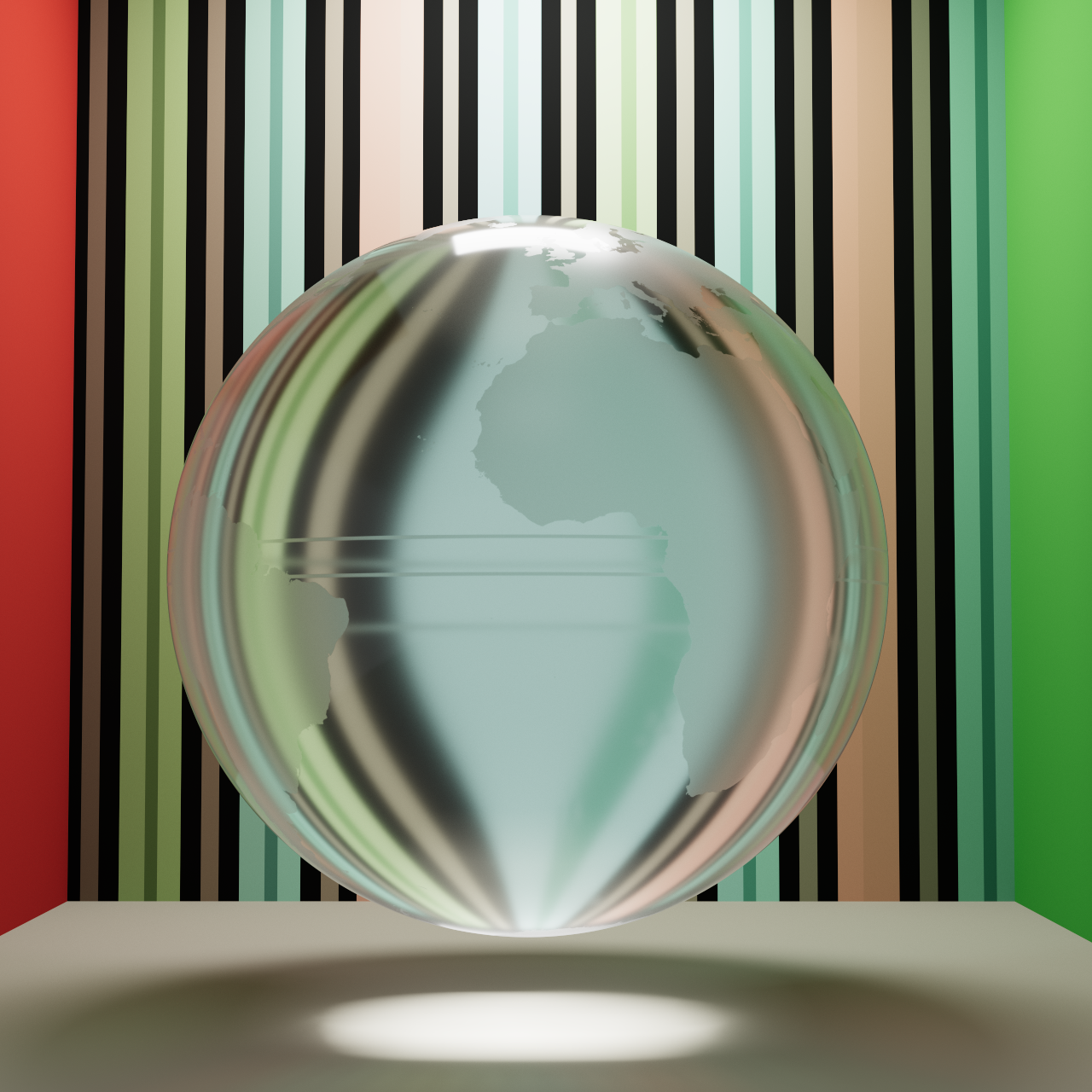
The scene
The scene brings several rendering challenges:
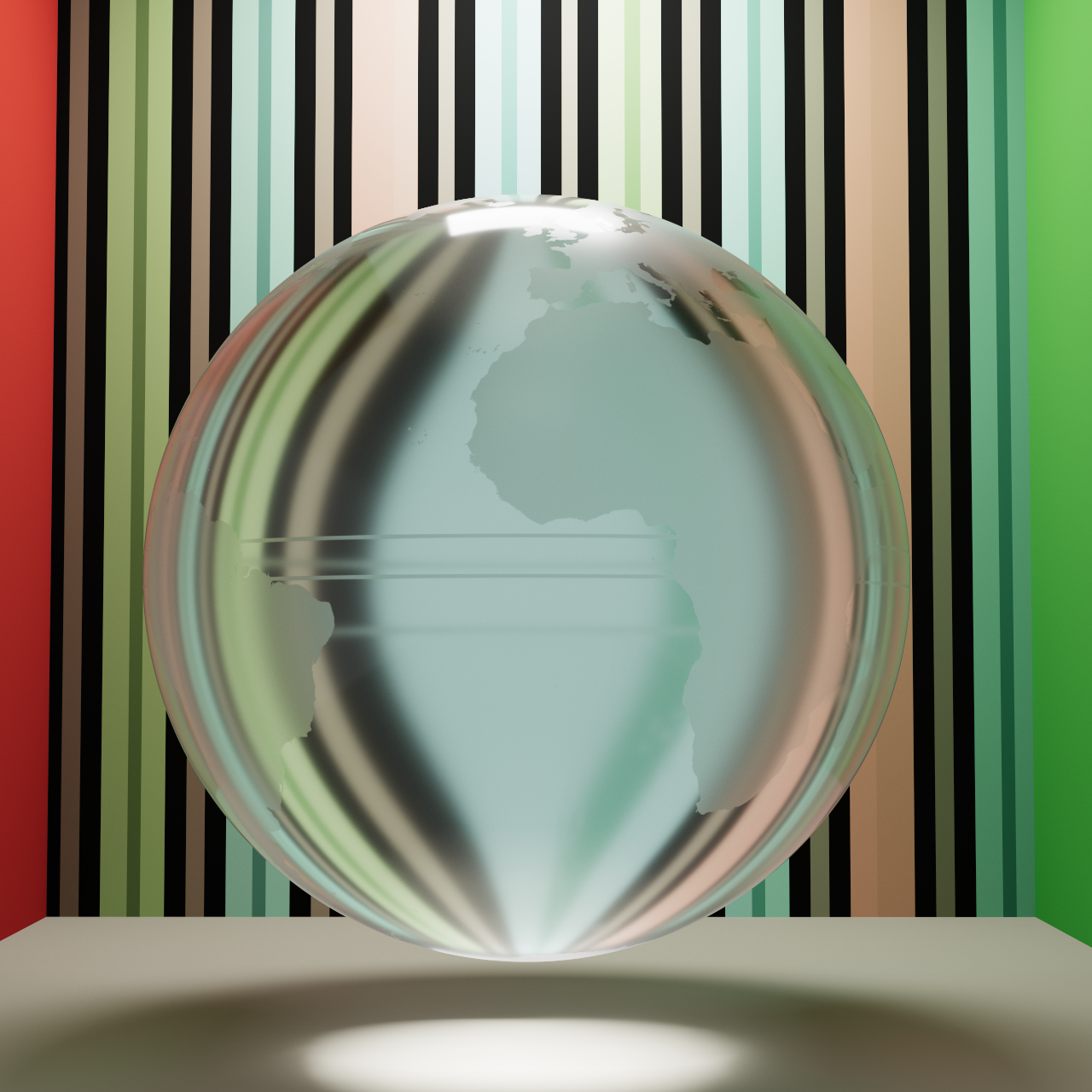
- Rough glass. A solid glass sphere combines reflection and refraction with spatially varying roughness. The continents are rougher than the oceans - their shapes come entirely from the roughness texture. Ocean roughness is 0.1 and land roughness is 0.3, using glTF’s GGX convention. Note that original figure used Beckmann roughness but I used GGX which is more common nowadays. The index of refraction is 1.5 (average glass).
- Striped backdrop. Narrow colored and black stripes make the distortion and blur from rough transmission easy to see. The globe itself has no intentional absorption tint.
- Caustics. A rectangular light above the globe produces a bright caustic on the floor.
- Camera and placement. The scene includes two 30-degree vertical-FOV cameras: ZoomOut, the default wider framing, and PaperMatch, the tighter framing fitted closer to the paper figure.
Light is a rectangle above the globe. The separate environment map is constant linear RGB (0.4, 0.4, 0.4). If you want your render to be more contrasty like original Figure 1, reduce or remove the environment lighting.
Renders
Path traced with BSDF sampling only (no NEE) and up to 48 bounces using Russian Roulette. 256,000 samples per pixel.
Download
License and Citation
The Earth outlines use public-domain Natural Earth land data.
The reconstruction, its included textures, and the environment map are released under CC0 1.0 Universal. You may use, modify, and redistribute them, including for commercial purposes. Please credit the paper that inspired the scene, and optionally my reconstruction:
@inproceedings{walter2007microfacet,
  author    = {Walter, Bruce and Marschner, Stephen R. and Li, Hongsong and Torrance, Kenneth E.},
  title     = {Microfacet Models for Refraction through Rough Surfaces},
  booktitle = {Proceedings of the Eurographics Symposium on Rendering},
  year      = {2007},
  url       = {https://www.cs.cornell.edu/~srm/publications/EGSR07-btdf.html}
}
Citation for this reconstruction:
@misc{boksansky2026walterglobe,
  author       = {Bok{\v{s}}ansk{\'{y}}, Jakub},
  title        = {Walter Globe: A {glTF} Reconstruction},
  year         = {2026},
  url          = {https://boksajak.github.io/blog/WalterGlobe},
  note         = {Reconstruction of the scene shown in Figure 1
                  of Walter et al., Microfacet Models for
                  Refraction through Rough Surfaces (EGSR 2007)}
}